There are few things more difficult for a car company than bringing back an icon.
Get it wrong and you’re accused of exploiting nostalgia. Get it too right and you risk making something that feels like a museum piece. Change too much and people wonder why you bothered using the old name in the first place.

Renault has decided to try anyway. The Renault 5 is back. So is the Renault 4. And now the Twingo is returning too. All three are electric. All three borrow heavily from their predecessors. But they’re not trying to recreate the past.
They’re doing something considerably more interesting. They’re using it as a design language for the future.


Three cars. Three generations.
The original Renault 4 arrived in 1961 as an inexpensive, practical answer to a changing France.
It was deliberately simple and versatile. Renault wanted something that could carry a family, transport goods and cope with roads that were considerably less forgiving than those we drive on today.

The Renault 5, which followed in 1972, was different. Smaller, sharper and considerably more fashionable, it became one of Europe’s defining superminis. It was a car of the 1970s and 1980s: youthful, colourful and increasingly associated with a generation for whom the small car represented freedom as much as practicality.
Then came the Twingo. When it arrived in 1992, it looked like nothing else on the road. Its single-volume body, enormous interior for its size and almost cartoon-like face made it feel more like a piece of industrial design than a conventional small car.
And that distinction matters. Because Renault isn’t simply bringing back three cars. It’s bringing back three different ideas about what a small car should be.
The 4 was about practicality. The 5 was about style. The Twingo was about simplicity and personality.

The new Twingo is a different kind of retro.
The forthcoming Twingo feels particularly interesting because its reference point is much more recent.
The original 4 and 5 have now become bona fide classics. Their shapes have acquired a certain historical distance.
The Twingo hasn’t had quite enough time to become that. Instead, Renault is tapping into something closer to 90s nostalgia.
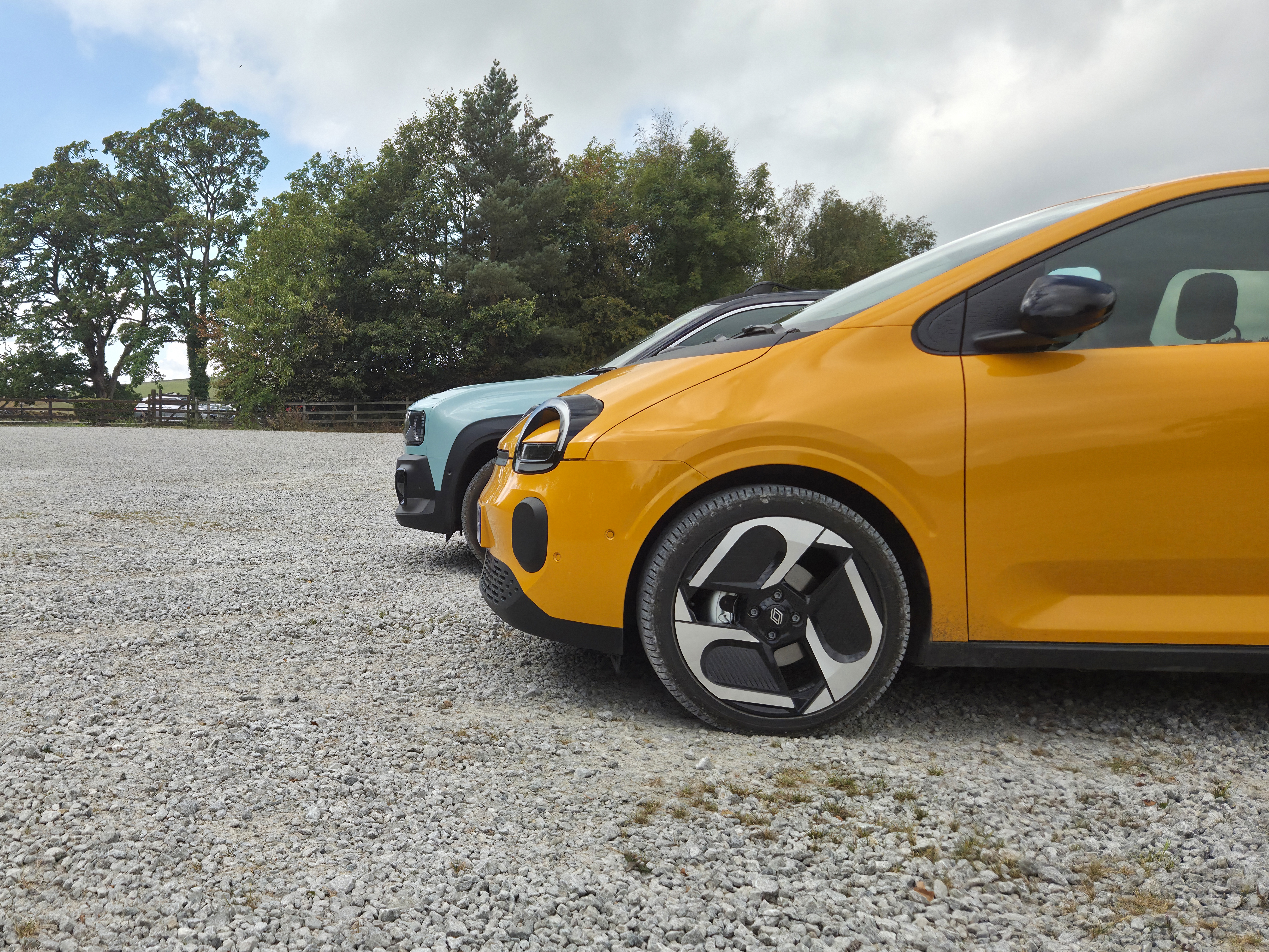
The new car deliberately recalls the friendly, slightly irreverent character of the original. The rounded headlights, compact proportions and upright glasshouse are obvious references, but the overall design is much cleaner and more contemporary.
It doesn’t look like a 1992 Twingo dragged through time. It looks like somebody remembered what made one charming and started again.
That’s an important distinction. Nostalgia works best when it isn’t too literal, and Renault has nailed this.

And then there’s the unusual bit: China
The new Twingo also represents something else entirely. It was developed through a collaboration between Renault’s design teams in France and its engineering operations in China, reflecting just how global the modern automotive industry has become.
That’s an interesting detail to attach to a car whose entire identity is rooted in French automotive culture.
The original Twingo was almost defiantly French. It emerged from a period when European manufacturers still designed small cars primarily for their own domestic markets.
The new one is a product of a very different industry. Its heritage is French. Its development is international. Its powertrain is electric.
And its intended market is global. That might make it less authentically French. Or it might be the most honest representation of what a modern French car actually is.

This is what retro design should look like
There’s a temptation when designing a modern interpretation of an old car to simply copy the obvious bits.
Make the headlights round. Add some chrome. Find the original badge. Job done.
The best retro designs don’t work like that. They understand what made the original distinctive and translate the underlying idea into something appropriate for the present.
That’s what Renault has done particularly well. The new 4 doesn’t have the exact proportions of a 1960s Renault 4 because it couldn’t. It has to pass modern crash tests. It needs batteries underneath it. It needs to accommodate modern occupants and satisfy a completely different set of expectations.
Instead, the designers have taken the idea of the original and stretched it into a modern form.
The 5 does the same thing. And the Twingo is perhaps the purest example of all. The details are familiar, but the execution belongs firmly to the 2020s.

Renault isn’t selling nostalgia. It’s capitalising on familiarity.
This is where I think Renault’s approach becomes particularly clever. The obvious reason for resurrecting famous names is marketing. And it’s becoming an increasingly visible tactic employed by “legacy OEMs” in the face of the wave of Chinese alternatives.
A recognised badge saves an enormous amount of work. But that’s only part of it. People don’t necessarily want the old car back. They want the feelings associated with it.
The Renault 4 represented practicality and freedom. The 5 represented youth and style. The Twingo represented simplicity and optimism. Those qualities can survive even when the mechanical ingredients don’t.
And that’s particularly important when the technology underneath has changed so dramatically.

Three analogue ideas. Three electric interpretations.
The irony is that these cars come from an overwhelmingly analogue automotive heritage.
The original 4 had a tiny four-cylinder engine, a manual gearbox and a remarkably simple interior.
The original 5 was hardly more sophisticated.
The first Twingo arrived with a conventional petrol engine, physical controls and almost no technology by modern standards.
Their descendants are the opposite. Electric motors. Battery packs. Touchscreens. Connectivity. Software. Regenerative braking. Over-the-air updates.
Yet somehow the new cars still communicate something of their predecessors. That might be the most interesting thing about them. Heritage doesn’t have to disappear when technology changes.
It can be translated.

The changing definition of a small car.
There’s another story here too. The original 4, 5 and Twingo were born into periods when small cars were fundamentally about affordability.
They were inexpensive ways of giving people mobility. That’s much harder to achieve today. Safety regulations have increased. Technology has become more expensive. Batteries aren’t cheap. Customers expect levels of comfort and equipment that would have seemed absurd in a 1990s supermini.
And yet Renault is still trying to make small cars desirable. That’s why the electric 4, 5 and Twingo matter.
They’re part of a wider attempt to prove that electrification doesn’t have to mean every car becoming larger, heavier and more expensive.
The small car still has a future. It just has to find a new way of getting there.

The Twingo’s the most interesting of the three
Not necessarily because it’s the best. In fact, by any consequential measurement, it’s the least impressive of the three. But it’s interesting because of what it represents.
The 4 and 5 were both enourmously successful cars that have had decades to establish their place in automotive history. Bar a slightly niche following on the European youngtimer’s scene, the Twingo hasn’t.
The Twingo is something else entirely. For someone who grew up in the ’90s, the Twingo isn’t ancient history. It’s childgood.
And Renault seems to understand the next wave of classic-car affection won’t necessarily begin with the E-Type or a Pagoda Mercedes. It’ll begin with the cars that were ordinary when today’s enthusiasts were growing up.
Renault is one of the first major manufacturers to lean into that idea.

The past isn’t coming back
That’s perhaps the most interesting lesson from Renault’s recent revival. The Renault 4 isn’t really a 1960s car. The Renault 5 isn’t really a 1970s car. And the new Twingo certainly isn’t a 1990s car.
They’re modern interpretations of old ideas. And that’s why they work.
The best way to respect automotive history isn’t to freeze it. It’s to let it evolve.The 4 changed because the world around it changed. So did the 5. So did the Twingo.
And now they’ve all changed again. Different technology. Different expectations. Different roads. But the same basic ideas remain.
A small car can still be useful. It can still be affordable. It can still have personality. And perhaps most importantly, it can still tell us something about the time in which it was built.
Renault isn’t bringing the past back. It’s using the past to explain where it’s going next. And that’s a much more interesting reason to revive a name.